Ceramics vs pottery: what is the difference?
Pottery is a type of ceramic, not a rival to it. Ceramic is the whole family of fired clay and mineral objects; pottery is the branch made from clay on the wheel or by hand. The real differences show up in the clay body and the cone it fires to.
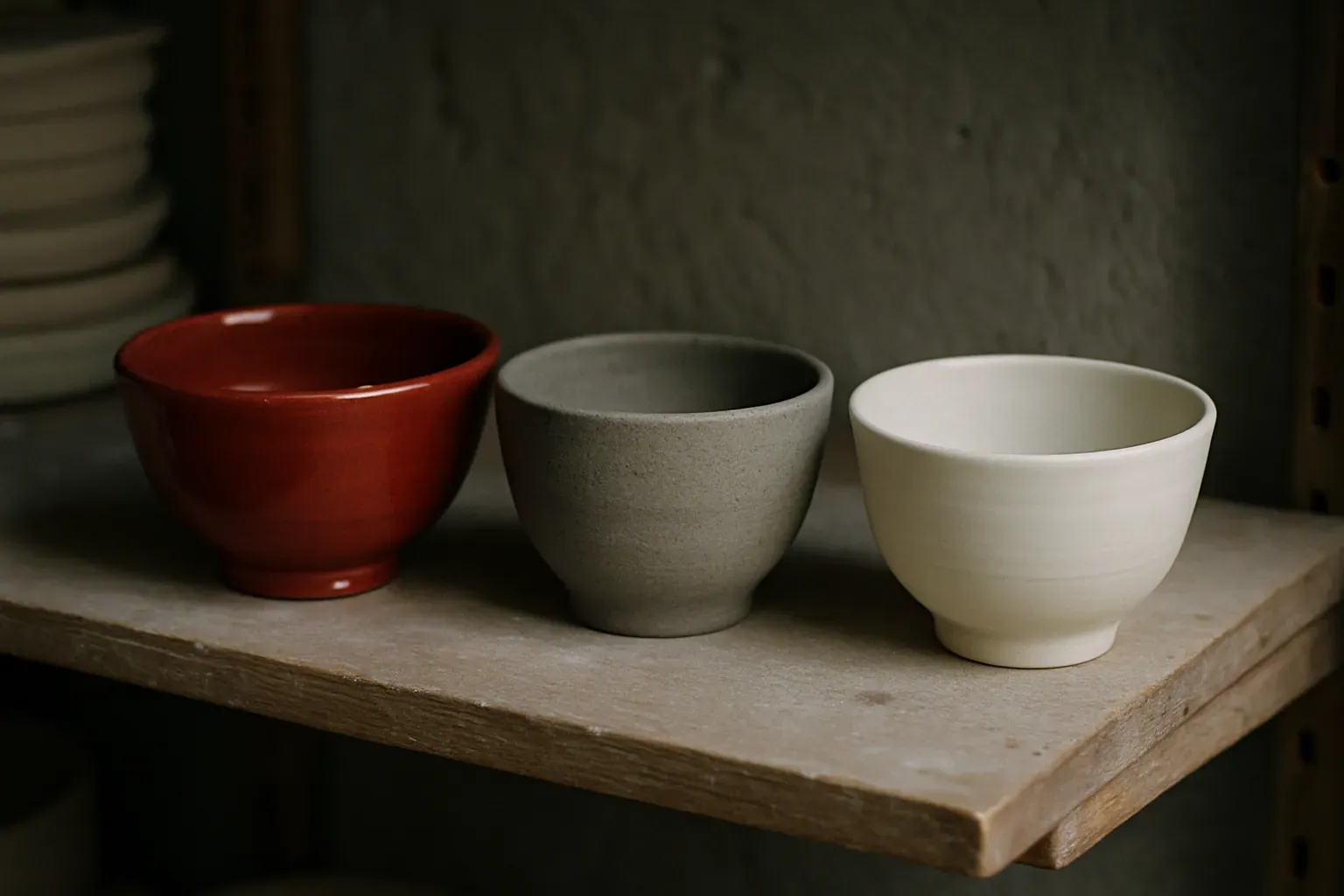
Pottery is one kind of ceramic. Ceramic is the whole family of hard materials made from fired minerals, and pottery is the branch of it you can throw on a wheel. The oldest known pots are about 20,000 years old. The oldest known fired ceramic object is a small figurine several thousand years older than that, and it holds nothing at all. In a studio the difference that matters is narrower: which clay body you bought, and which cone it has to reach.
Is pottery the same thing as ceramics?
No, and there are two published definitions that draw the line cleanly. The American Ceramic Society defines ceramics as nonmetallic, inorganic materials, mostly crystalline, including oxides, nitrides, carbides, and borides. The ASTM International terminology standard for ceramic whitewares defines pottery much more tightly: all fired ceramic ware that contained clay when it was formed, minus the technical, structural, and refractory products.
Read that second definition as a two-part test. Was there clay in it when you shaped it? And is it something other than a brick, a kiln shelf, or a spark plug? Pass both and it is pottery. A mug passes; a floor tile fails the second half, and an optical fiber fails both.
In daily speech the words overlap, and that is fine. A studio potter who says "my ceramics" means their pots, and no one is confused. The distinction earns its keep when you are buying material or reading a spec sheet, because the ceramics aisle is much wider than the pottery aisle.
What is a ceramic but not pottery?
Open your kiln and most of what you see qualifies. The insulating firebrick in the walls is a refractory ceramic. The shelves are cordierite or silicon carbide. The element holders are ceramic. So is the pyrometric cone you stand on the shelf to check the firing, which is a ceramic formulated to slump at a known amount of heat-work. None of that is pottery. All of it is ceramic.
Outside the studio the list gets longer. The American Ceramic Society groups the traditional side as refractories, structural clay products, whiteware, earthenware, abrasives, and cements, and the advanced side as medical, electrical, optical, and structural ceramics. That second group covers the catalytic converter substrate in a car, a dental crown, the cover glass on a phone, ceramic armor, and cutting tool tips.
Bricks and roof tiles are the interesting edge. They do contain clay, so they pass the first half of the test and fail the second: they are structural clay products, which the standard puts outside pottery. So the clean way to hold it in your head is this. Pottery is the ware you make. Ceramic is the material class that also covers the kiln you make it in.
Which came first, ceramics or pottery?
Ceramics, by a wide margin. The Venus of Dolni Vestonice, found in Moravia in 1925, is a fired clay figurine 111 mm (4.4 in) tall, dated to roughly 29,000 to 25,000 BC and fired somewhere near 500 to 800 C. It is one of the oldest known fired ceramic objects, along with other pieces from the same site. It is also not pottery in the everyday sense: no vessel, nothing to pour from.
The oldest known pottery is much later. Sherds from Xianrendong Cave in Jiangxi, China were dated to 20,000 to 19,000 years before present by Wu and colleagues in Science in 2012. The people who made them were mobile foragers living through the Last Glacial Maximum, which puts the first cooking pots thousands of years ahead of farming rather than after it.
People fired clay into shapes for a long stretch before anyone fired clay into a container. That gap is the distinction in one artifact.
What are the three types of pottery clay?
Almost all studio pottery is earthenware, stoneware, or porcelain. They are not brands or styles. They are clay bodies that vitrify, meaning turn dense and glassy, at different temperatures, and that one difference drives nearly everything else about how a pot behaves.
| Clay body | Typical cone | Peak at 108 F per hour | Character |
|---|---|---|---|
| Earthenware | cone 06 to 04 | 1828 to 1945 F (998 to 1063 C) | Porous, bright color, low fire |
| Stoneware | cone 5 to 7 | 2167 to 2262 F (1186 to 1239 C) | Dense, watertight, mid-range |
| Porcelain | cone 6 to 10 | 2232 to 2345 F (1222 to 1285 C) | White, strong, high fire |
Those are Orton self-supporting cone equivalents at a final heating rate of 108 F per hour, which is close to what a controller runs on medium speed. Fire the last stretch faster and every one of those numbers goes up.
Earthenware
Earthenware is low-fire clay. It matures around cone 06 to cone 04, 1828 to 1945 F, and stays porous after firing, so bare earthenware meant to hold liquid gets glazed and fired again. Terracotta plant pots are the classic unglazed example, red because of the iron in the clay. The trade is a soft, absorbent body in exchange for bright color and a cheap, forgiving firing. Low-fire glazes hold reds, oranges, and yellows that burn out at stoneware temperatures.
Stoneware
Stoneware fires to cone 5 to 7, 2167 to 2262 F, and vitrifies into a hard body that holds water on its own. That is why so much everyday dinnerware is stoneware. Cone 6 in an electric kiln is the most common setup in home and community studios, and the glaze recipes at that cone are the best documented of any range. It chips less than earthenware and forgives more than porcelain.
Porcelain
Porcelain is made from refined white materials, mostly kaolin with feldspar and silica. Traditional porcelain fired to cone 9 or 10, up near 2345 F, and plenty of studios still work there. Mid-range porcelain bodies now mature at cone 6, so the old shorthand of porcelain equals high fire no longer holds. What stays true is the result: a dense body that passes light through a thin wall, and a narrow window at the peak where one cone too many puts the foot down on the shelf. The clay versus porcelain comparison has the measured absorption and shrinkage figures.
Where do china, bone china, and terracotta fit?
All three are pottery, and all three are ceramics. The names describe recipes, not categories.
Terracotta is earthenware, usually unglazed and iron-red. China and fine china are porcelain under a shop-floor name. Bone china is the odd one: the traditional recipe is about 50% bone ash with roughly 25% kaolin and 25% Cornish stone, and the industry floor for using the name at all is 30% bone ash.
Bone china also fires backwards from studio practice. Factories bisque it high, near 1250 C, then glost fire the glaze lower, around 1050 to 1100 C. A studio does the opposite: a low bisque near cone 06 to leave the ware porous enough to drink up glaze, then a hotter glaze firing to the maturing cone of the body. Two firings either way, opposite order of heat, and the guide on bisque versus glaze firing covers why the studio version works the way it does.
Why the cone matters more than the clay name
The name on the bag matters less than the cone you reach. Vitrification is the point where clay particles fuse and the pot stops being porous. Fire below it and the body stays weak and absorbent. Fire past it and the pot can slump, bloat, or stick to the shelf. A firing schedule is written around a target cone for that reason, never around a target style.
A cone measures heat-work, not temperature. It reads time and temperature together, so the same cone bends lower on a slow final ramp and higher on a fast one. Orton publishes its equivalents at stated heating rates, and the spread is real: cone 6 lands at 2232 F at 108 F per hour and 2269 F at 270 F per hour. The full ladder is in the Orton cone chart.
Earthenware and stoneware often share a bisque firing, a slow low fire near cone 06 that drives off water and organics. The clays part company at the glaze firing, when each one climbs to its own maturing cone.
How do I know which clay I am using?
Read the bag. Clay is sold with its firing range printed on it, like cone 06 to 04 for earthenware or cone 5 to 6 for mid-range stoneware. Match the program to that range, and stand a witness cone in the load to confirm the kiln actually got there.
With a finished pot and no bag, work down the tells. Look at the unglazed foot ring first, since that is the only place the raw body shows. A gritty red or buff foot that scratches with a fingernail points to earthenware. A dense grey or brown foot points to stoneware. A white foot on a thin wall points to porcelain. Then tap the rim: a vitrified body rings, an underfired one thuds.
If you want a number rather than a guess, weigh the piece dry, soak it, and weigh it again. The water it takes on as a percentage of its dry weight is its absorption, the same measurement the tile industry runs under ASTM C373. Under 0.5% counts as impervious, 0.5 to 3.0% as vitreous, and anything over 7% as non-vitreous, which is where most earthenware sits.
Once you know the cone, the schedule is arithmetic. Set the cone and the speed in the firing schedule builder and it writes the ramps and holds for you, whether that is a load of earthenware planters or a set of cone 6 mugs.
The short version
Ceramics is the family. Pottery is the clay branch of it, minus the bricks, the kiln shelves, and the spark plugs. Inside pottery, earthenware, stoneware, and porcelain differ mainly by the cone they fire to: low, mid, and high. Get the cone right and the pot comes out strong and watertight. Get it wrong and no clay name will save it.
Sources
- The American Ceramic Society, What Are Ceramics? The definition and the traditional/advanced category list (ceramics.org).
- ASTM International, Standard Terminology of Ceramic Whitewares and Related Products (C242): pottery as fired ceramic ware containing clay when formed, excluding technical, structural, and refractory products.
- Wu X. and colleagues, Early Pottery at 20,000 Years Ago in Xianrendong Cave, China, Science, 2012.
- Venus of Dolni Vestonice, Moravia, a 111 mm fired clay figurine dated 29,000 to 25,000 BC and fired at roughly 500 to 800 C.
- Orton pyrometric cone temperature chart, self-supporting cones at 108 F and 270 F per hour (ortonceramic.com).
- ASTM C373 water absorption classes as applied to tile bodies: impervious, vitreous, semi-vitreous, non-vitreous.
Build your firing schedule
Pick your clay cone, choose bisque or glaze, set a speed, and print the ramp and hold sheet free.