How long does it take to fire pottery?
A bisque firing takes 7 to 13 hours to reach temperature and a glaze firing 6 to 11, then the kiln needs at least that long again to cool. Skutt's Cone Fire programs run about 12 hours on slow, 7.5 on medium, and 4 on fast for a cone 04 firing from a 70 F start. Add the cooling and one load ties up the kiln for a full day.
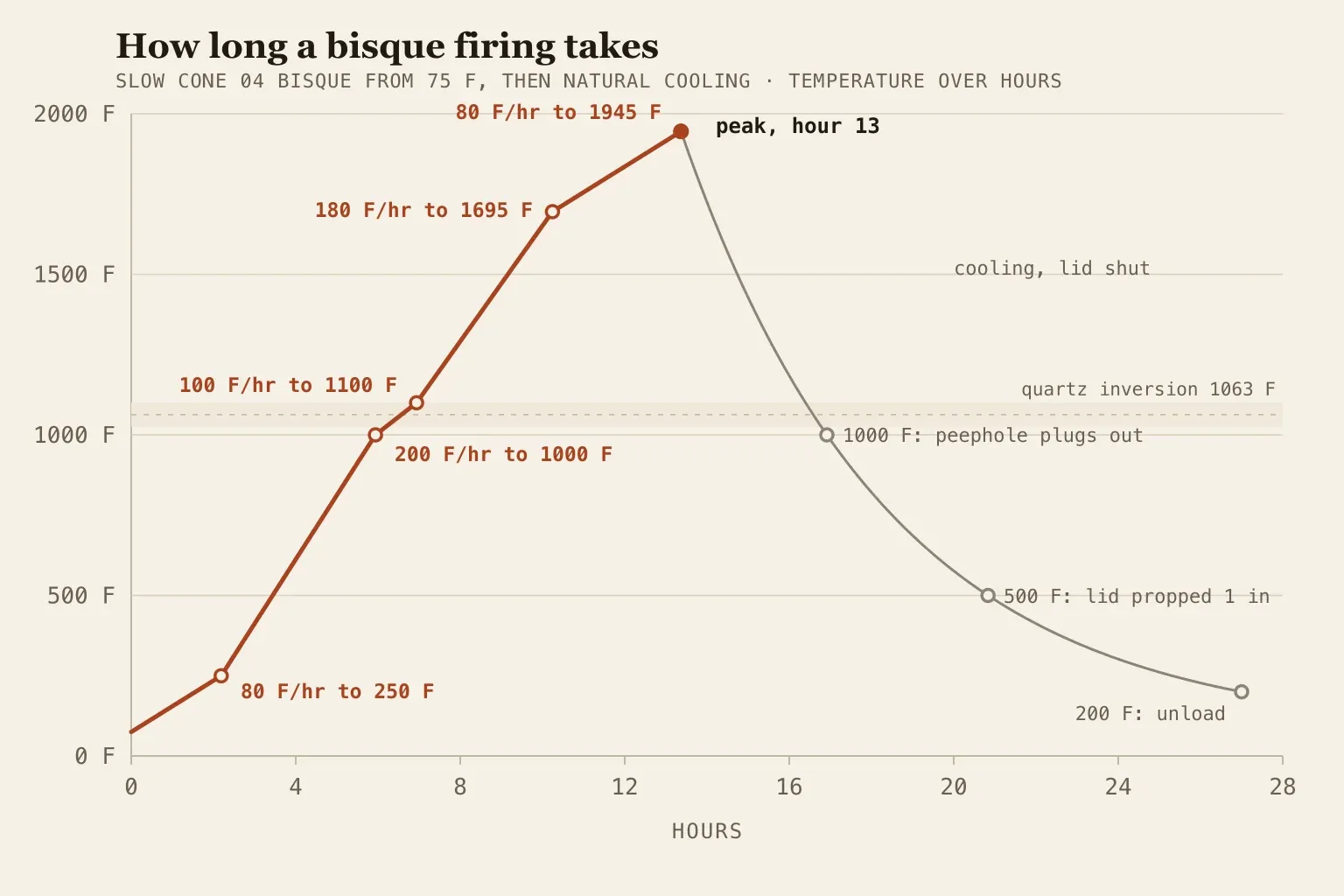
Those are the hours to the peak, and the peak is only half the job. A pot goes through the kiln twice, once as bisque and once with glaze on it, and each trip is a climb plus a cool. So the honest answer to the question is about two days of kiln time per pot, spread over two loads, and most of that time is spent waiting for the kiln to come back down.
How many hours is a bisque firing?
Between 7 and 13 hours to reach the cone, and the slow end is the normal one. The Bartlett slow bisque, the factory program inside most electric kiln controllers, takes 13 hours to reach cone 04 at 1945 F (1063 C). Its fast bisque does the same climb in 10 hours 14 minutes. Skutt's own slow program is a little quicker at about 12 hours because it climbs faster through the middle.
The slowness is the point. Greenware still holds water even when it feels dry, and that water has to leave as steam before the kiln passes the boiling point, so the first segment crawls at 80 F per hour up to 250 F. Then the organic matter and carbon in the clay burn out below 1000 F. Then the kiln eases through quartz inversion near 1063 F (573 C), where the silica in the clay expands and a fast ramp can crack a piece. Only after 1100 F does the program open up to 180 F per hour, and it slows again to 80 for the last 250 F so the cone gets an accurate reading of heat-work.
Skutt's manual says fast speed is probably not the best choice for a bisque, for the same reasons: it does not give the water enough time to leave or the clay enough time to change. Worked out segment by segment in the bisque firing schedule guide, the slow program is where every one of those hours goes.
How many hours is a glaze firing?
Between 6 and 11 hours, and the cone matters less than you would think. The ware is already bisqued, so there is no water to drive off and no carbon to burn, and the early ramps can run at 300 to 500 F per hour. A cone 6 glaze firing on medium speed takes about 8 hours 13 minutes in the schedule builder. Slow speed takes 10 hours 27 minutes and fast 6 hours 23 minutes.
Stepping up from cone 6 to cone 10 adds only 19 minutes on the same medium program. The final 250 F segment is the same length for either cone, and the extra 113 F of climb is covered at 350 F per hour on the segment before it. Speed changes the total far more than cone does. That final rate is also what sets the cone: Orton rates its cones at 108 F per hour over the last 180 F of the firing, and a slower final ramp reaches the same cone at a lower temperature because the clay has had longer to absorb heat. The builder reads its peak from the Orton column closest to the final rate you chose, which is why the fast programs in the table below end a few degrees higher.
| Firing | Cone | Slow | Medium | Fast |
|---|---|---|---|---|
| Bisque | 06 (1828 F) | 12 hr 43 min | 9 hr 25 min | 6 hr 40 min |
| Bisque | 04 (1945 F) | 13 hr 22 min | 9 hr 53 min | 7 hr 0 min |
| Glaze | 06 (1828 F) | 9 hr 7 min | 7 hr 3 min | 5 hr 21 min |
| Glaze | 04 (1945 F) | 9 hr 30 min | 7 hr 23 min | 5 hr 39 min |
| Glaze | 6 (2232 F) | 10 hr 27 min | 8 hr 13 min | 6 hr 23 min |
| Glaze | 10 (2345 F) | 10 hr 50 min | 8 hr 32 min | 6 hr 40 min |
Final ramp is 80 F per hour on slow, 120 on medium, and 200 on fast. Peak temperatures are Orton equivalents at 108 F per hour; fast programs read the 270 F per hour column, so cone 04 fast ends at 1971 F rather than 1945 F. Loaded kilns run longer than these numbers.
How long does the kiln take to cool?
At least as long as it took to heat, and often longer. That is the studio rule of thumb, and The Pottery Wheel's cooling guide puts a kiln that climbed for 12 hours at 12 to 24 hours of cooling with the lid shut. Larger kilns, thicker walls, and a dense load all stretch it. L&L's line on cooling is to leave the kiln alone until it reaches 200 F, then open it and unload, and their support pages put the safe point for propping the lid an inch on a kiln post at around 500 to 600 F, with the peephole plugs staying in until about 1000 F.
The reason is the ware, not the kiln. A hot pot hit with cool air shrinks on the outside faster than the inside and cracks, and a glaze that cools too fast crazes. If you hear pinging from the shelves, the glaze is telling you it cooled too quickly. Quartz inversion is a hazard on the way down as well as on the way up, since the silica shrinks back through 1063 F, so the hours between 1100 and 1000 F are not the ones to rush.
Two things shorten the wait without cheating. A downdraft vent left running pulls room air through the chamber, and L&L puts the saving at about a third of the cooling time. And a lightly loaded kiln holds less heat. The Glazy wiki collects potters' rules on opening, and the strictest of them is Ivor Lewis's: unload when you can hold the pots with bare hands, not gloves. For glazes that want the slow drop on purpose, the slow cooling glaze effects guide covers the controlled version.
Factory profiles are written for the fastest possible empty kiln. L&L prints that warning on its Easy-Fire profile page in capitals: the segment times do not represent typical firing times with a load.
Source: L&L Kiln Mfg., DynaTrol Easy-Fire program profiles (hotkilns.com).Why does the same program take longer in my kiln?
Because the table is a schedule, not a promise. A controller can ask for 180 F per hour, but the elements decide whether the kiln gets there, and four things pull the real time out past the program.
- A full load. A dense stack of shelves and thick ware soaks up heat and slows the climb, so the same slow bisque that finishes in 13 hours empty can run an hour or two longer packed.
- Worn elements. Elements lose power with every firing. Skutt's Cone Fire mode watches the actual rate over the last hour and adjusts the finish temperature so the cone still comes out right as the elements weaken. The result stays honest. The firing gets longer.
- Low voltage. A kiln rated for 240 V on a supply that sags under load fires slower in the evening when the neighborhood is cooking, and there is nothing in the program that can fix that.
- Candling and holds. A preheat hold near 200 F for damp or thick work adds every minute of that hold to the total, and a 15 minute soak at peak adds 15 minutes. The candling and preheating guide covers when the extra time is worth it.
Digitalfire's test for a healthy schedule on a healthy kiln is that you can predict the end of the firing within 5 to 10 minutes. If your kiln drifts past its projected finish by an hour, look at the elements before you look at the program.
How long from wet clay to a finished pot?
About two days of kiln time, after however long the piece takes to dry. The drying is the part nobody can put a number on, since a thin cup on a warm shelf is bone dry in a couple of days and a thick slab bowl wrapped in plastic can take two weeks. Once it is dry, the sequence is fixed: a bisque climb of 10 to 13 hours, a cool of 12 to 24, a glaze climb of 7 to 10, and a second cool of 12 to 24. That is 41 to 71 hours between loading the greenware and holding the glazed pot.
In practice that is a rhythm rather than a countdown. Load a slow bisque at 6 pm and it reaches cone 04 around 7 am. The kiln is cool enough to unload by that evening or the next morning. Glaze during the day, load a cone 6 firing at 8 pm, and it finishes around 4 am, ready to open the following afternoon. Two loads a week is a comfortable pace for one kiln, and the builder prints the total hours on every schedule so you can pick the start time that lands the finish where you want it.
Plan the firing around the clock
Pick the cone, bisque or glaze, and speed in the firing schedule builder and it writes the ramps, the holds, and the total time to peak, in F or C. The number to plan around is that total plus the same again for cooling. For the mid-range setup most electric studios run, the worked cone 6 glaze firing schedule shows where each of its 8 hours goes.
Sources
- Skutt KilnMaster operating manual, Cone Fire mode: slow about 12 hours, medium about 7.5 hours, fast about 4 hours for a cone 04 firing from 70 F, and the note that fast speed is a poor fit for bisque (skutt.com).
- L&L Kiln Mfg., DynaTrol Easy-Fire program profiles and the knowledgebase pages on cooling and on which program to use (hotkilns.com).
- Digitalfire reference, firing schedule glossary and the Bartlett BTFB04 fast bisque schedule: 13 hour slow bisque, 10 hour 14 minute fast bisque to 1945 F (digitalfire.com).
- Glazy Ceramics Wiki, kiln cooling: Ivor Lewis's bare-hands rule and Arnold Howard of Paragon Industries on refractory damage from fast cooling (wiki.glazy.org).
- The Pottery Wheel, how long does it take for a kiln to cool down (thepotterywheel.com).
- Cone temperatures are Orton self-supporting cone equivalents at a heating rate of 108 F per hour, or 270 F per hour for the fast programs.
Build a schedule with the hours on it
Pick the cone, bisque or glaze, and a speed. The sheet prints the ramps, the holds, and the total time to peak.