Underglaze vs glaze: what is the difference?
Underglaze is colored clay that stays where you paint it and fires to a matte finish. Glaze is powdered glass that melts in the kiln and seals the pot. One carries the image, the other carries the shine and the waterproofing. Most functional pots use both: underglaze first, a clear glaze over it.
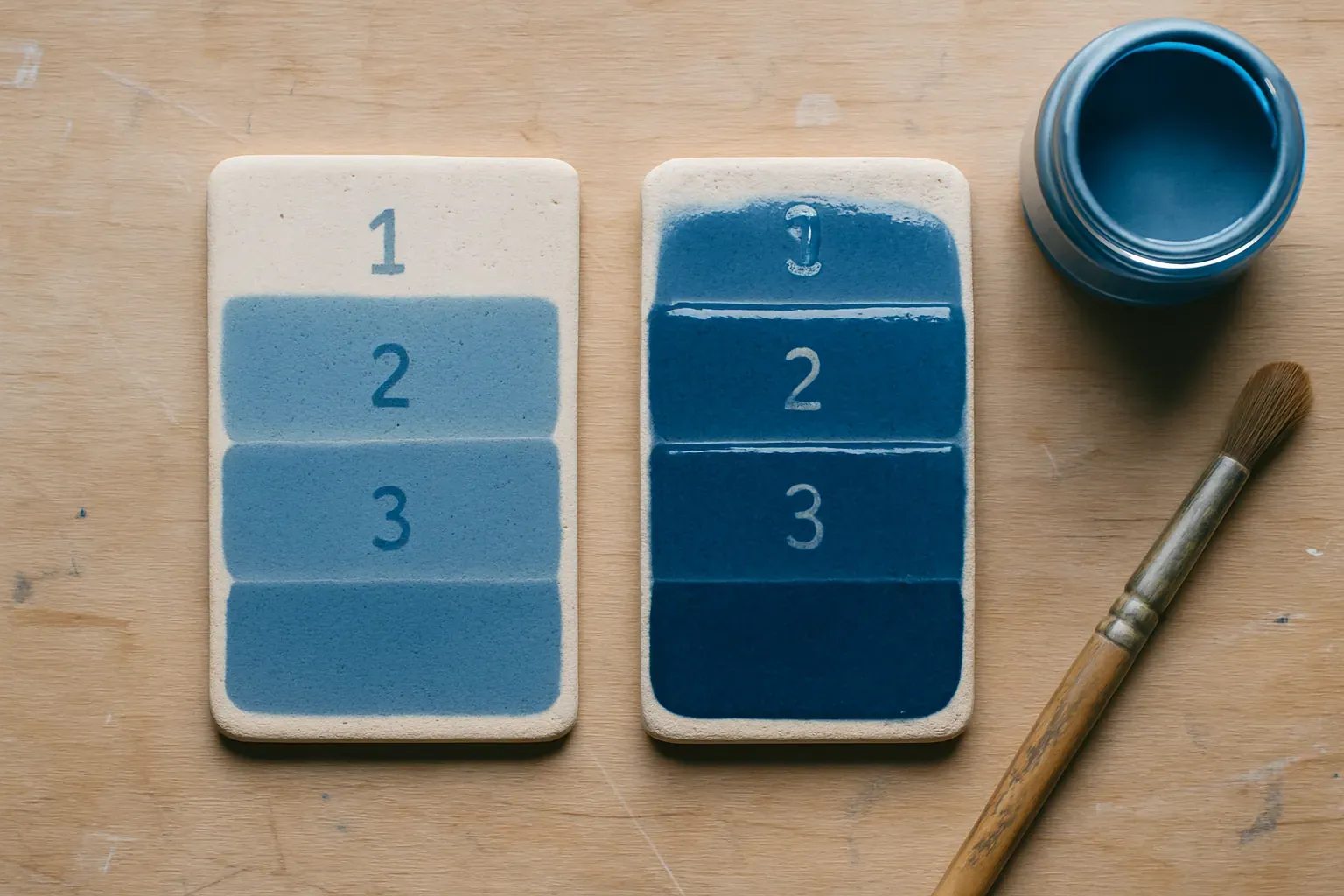
Underglaze and glaze, side by side
The two materials sit side by side on the studio shelf, go on with the same brushes, and get mixed up constantly. In the kiln they behave nothing alike. AMACO rates its Velvet underglazes for application on wet clay, greenware, or cone 04 bisque, a range no glaze could tolerate, because a glaze has one job the underglaze must never do: melt.
| Property | Underglaze | Glaze |
|---|---|---|
| What it is | Colored clay: stain, clay, a little flux | Powdered glass: silica, flux, alumina |
| Goes on | Wet clay, greenware, or bisque | Bisque only |
| In the kiln | Sinters and stays put | Melts and flows |
| Fired surface | Matte and porous | Gloss or satin, sealed |
| Matures in | The bisque firing, near cone 06 | The glaze firing, cone 6 for mid-range |
| Waterproofs the pot | No | Yes |
What is underglaze made of?
Three things: a ceramic stain for the color, a fine clay to bond it to the pot, and a small amount of flux so it tightens in the firing. The Digitalfire reference formula starts at a 50:50 mix of clay and flux, with the least stain that still reads bright. Gums go in last so it brushes like paint.
That recipe explains the behavior. Underglaze is mostly clay, so it shrinks with the pot instead of sliding across it, and the low flux content means it sinters rather than melts. Sintering fuses the particles where they touch and stops there. So the color you paint at the bench is close to the color you unload, a brushed edge stays sharp, and a sgraffito line carved through a coat keeps its corners.
Coverage is a coat-count decision. Two or three coats build a solid, opaque field of color. One thinned coat reads like a watercolor wash over the clay. Either way the surface fires matte and dry to the touch, with no gloss of its own.
What is glaze made of?
Glass, in powder form. A glaze recipe balances three jobs: silica is the glass former, fluxes such as sodium, potassium, calcium, and boron pull the melting point of silica down into kiln range, and alumina stiffens the melt so it clings to a vertical wall instead of running onto the shelf.
At temperature the whole coating melts into a liquid and cools into a thin sheet of real glass. That melt is the point. It seals a porous clay body, gives the surface its gloss or its satin, and locks whatever sits underneath it. It also moves. A glaze applied as a crisp band can finish the firing as a soft-edged drip. Glaze painters use that flow on purpose. Line painters reach for underglaze to avoid it.
When do you apply each one?
Underglaze goes on early: wet clay, leather-hard greenware, or bisque all work. Glaze goes on bisque, because dipping raw clay into a bucket of wet glaze is a fast way to dissolve the pot. On a decorated pot the order is fixed: underglaze, bisque firing, clear glaze, glaze firing.
Two numbers anchor that sequence. A bisque firing lands near cone 06, about 1828 F (998 C), and leaves the ware porous enough to pull glaze out of suspension. A mid-range glaze firing then takes the pot to cone 6, about 2232 F (1222 C), where the clear coat melts over the decoration. Both figures are Orton equivalents at a heating rate of 108 F per hour, and the guide on bisque versus glaze firing covers why the two firings are programmed differently.
Painting on greenware has a practical payoff: a mistake wipes off with a damp sponge before the bisque, and the bisque firing hardens the decoration so the clear coat can go over it without smearing. Underglaze on bisque works too. It dries almost on contact, so brush with a loaded brush and apply the clear glaze with a gentle hand, since a fresh coat can lift if you scrub it.
Can you leave underglaze bare, with no clear glaze?
Yes, and on sculptural work it is a deliberate look. Fired bare, a Velvet underglaze keeps the soft matte surface the line is named for. What a bare underglaze never does is seal the pot. The surface stays porous, marks easily, and holds no water.
So anything that touches food or drink gets a clear glaze over the decoration. The AMACO spec is plain about it: the Velvets are food safe with a proper glaze over them, not on their own. The clear coat changes the color too. Most stains deepen and saturate under a gloss, which is why studio test tiles are painted half bare, half cleared.
One caution from Digitalfire: a thick, heavily gummed underglaze layer can gas under the clear coat and leave a cloud of micro-bubbles that dulls the image. Keep coats thin and even, and fire one test tile before you commit a kiln load of decorated ware.
Source: Digitalfire reference glossary, underglaze.Do underglaze colors survive a cone 6 firing?
Most hold, some drift. AMACO rates the Velvet line true to color at cone 05/06 and through cone 6 for most of the range, with some colors staying true to cone 10. The Studio Manager cone 6 tile tests put names on the drift: V-309 Deep Yellow and V-326 Medium Blue hold, V-354 Leaf Green shifts toward forest green, and V-375 Maroon frosts white under a glossy clear.
The reason is heat-work. A ceramic stain is stable up to a certain amount of heat, and past that point the color chemistry breaks down or dissolves into the melt above it. Reds and pinks are the usual casualties at higher cones, while blues and blacks shrug off almost anything. None of this shows on the jar label, so the standard studio move is one tile per color: one, two, and three coats, half bare and half under your own clear glaze, fired on your own schedule. Set that schedule in the firing schedule builder, or start from the worked cone 6 glaze firing schedule.
The short version
Underglaze is decoration, glaze is glass. Underglaze goes on first, stays put, fires matte, and needs a clear coat before the pot can hold soup. Glaze melts, moves a little, and does the sealing. Paint the image, bisque near 1828 F, clear it, then fire to the cone your clay asks for. The kiln handles the rest.
Sources
- AMACO Velvet underglaze product specifications (shop.amaco.com).
- Digitalfire reference glossary, underglaze (digitalfire.com).
- The Studio Manager, Velvet underglaze cone 6 test tiles (thestudiomanager.com).
- Glazy glaze basics, the roles of silica, flux, and alumina (glazy.org).
Build your firing schedule
Pick your cone, choose bisque or glaze, set a speed, and print the ramp and hold sheet free.