How hot does a kiln get?
A pottery kiln reaches about 1087 F (586 C) at the bottom of the Orton cone scale and about 2491 F (1366 C) at the top. Most studio work sits between those two ends: a bisque firing near 1828 F (998 C) at cone 06, and a cone 6 glaze firing near 2232 F (1222 C).
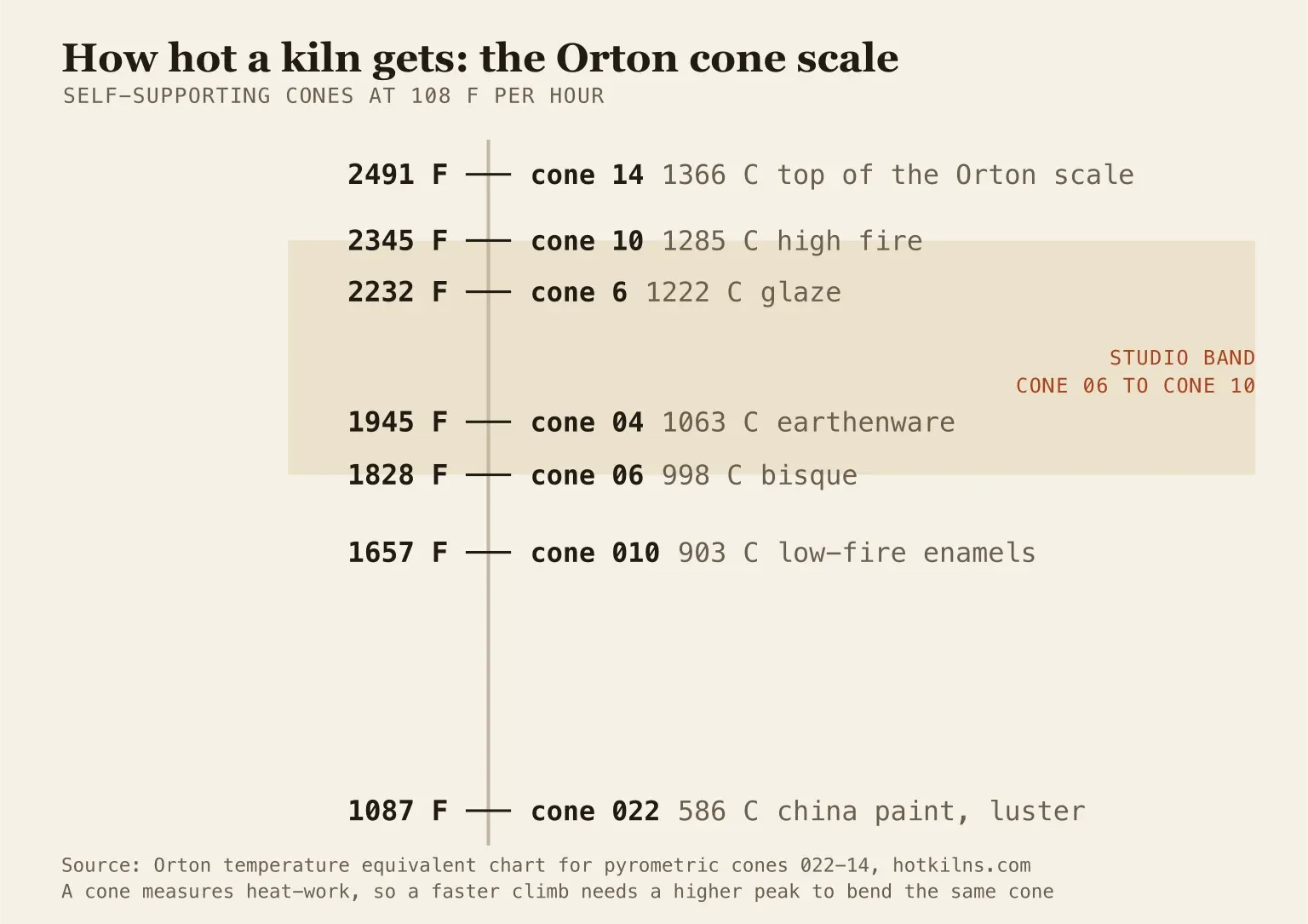
That range is wide enough to be useless on its own. The number you actually need is the one your clay and your glaze were formulated for, and a kiln that overshoots it by 60 F can slump a pot as thoroughly as one that undershoots it leaves the pot chalky.
Potters get around this by talking in cones rather than degrees. A cone is a small pyramid of ceramic material that bends when it has absorbed a set amount of heat, and the Orton scale runs from cone 022 at the cool end to cone 14 at the hot end. Every Fahrenheit figure below is quoted for a self-supporting Orton cone fired at 108 F per hour, because the same cone bends at a different temperature when the kiln climbs at a different pace.
How hot does a pottery kiln get?
Between roughly 1087 F and 2491 F (586 C and 1366 C), depending on the cone you fire to. Studio potters use a narrow slice of that: cone 06 for bisque near 1828 F, cone 6 for mid-fire glaze near 2232 F, and cone 10 for high fire near 2345 F. The rest of the scale belongs to enamels, lustres, and industry.
| Cone | Peak F | Peak C | What it is for |
|---|---|---|---|
| 022 | 1087 F | 586 C | China paint, luster, and decals, well below anything that hardens a pot |
| 010 | 1657 F | 903 C | Low-fire enamels and some glass work. A pot fired this high is still soft and porous |
| 06 | 1828 F | 998 C | The common bisque cone. Permanently ceramic, still porous enough to drink up glaze |
| 04 | 1945 F | 1063 C | Where earthenware and terra cotta mature, and where a lot of low-fire glaze is fired |
| 6 | 2232 F | 1222 C | Mid fire. The range most electric studios settle on for stoneware and functional ware |
| 10 | 2345 F | 1285 C | High fire. Traditional stoneware and porcelain, and the usual maximum on a hobby kiln |
| 14 | 2491 F | 1366 C | The top of the Orton scale. Industrial refractories and technical ceramics, not pots |
Notice how narrow the useful part is. From a cone 06 bisque to a cone 10 glaze firing is only 517 F, and the mid-fire range that most electric studios live in sits within about 100 F of 2232 F. Everything above cone 10 and below cone 010 is someone else's job.
Why is the same cone not always the same temperature?
Because a cone measures heat-work, meaning temperature and time together, not temperature alone. Hold a kiln at one number long enough and it does the same job as a higher number reached quickly. Orton publishes each cone against a stated heating rate for exactly this reason, and the spread is larger than most people expect.
Cone 6 is the clearest example. Fired at 27 F per hour it bends at about 2165 F. At 108 F per hour it bends at about 2232 F. At 270 F per hour it needs about 2269 F. That is a spread of over 100 F for one cone, driven by nothing but how fast the kiln was climbing. Orton applies those rates to the last 180 F of the firing, and notes plainly that the equivalent temperature goes up for faster rates and down for slower ones.
A soak counts as heat-work too. Orton reports that a cone held near its own equivalent temperature keeps maturing and will keep bending: one to two hours is enough to deform the next cone up, and four to six hours takes it two cones higher.
Source: Orton temperature equivalent chart for pyrometric cones 022-14, published by L&L Kilns (hotkilns.com).So a kiln that sat at 2232 F for an afternoon did not fire to cone 6. It fired to cone 7 or cone 8, with the surface to prove it.
This is why a controller display is a progress report rather than a verdict, and why a witness cone stays in the load. The pyrometer tells you the temperature at one point in the chamber, right now. The cone tells you what the whole firing added up to.
How hot does a kiln get for bisque and glaze firing?
Bisque runs near 1828 F (998 C) at cone 06, and a mid-fire glaze firing near 2232 F (1222 C) at cone 6. Those two numbers cover most studio firings. A high-fire glaze load goes to about 2345 F (1285 C) at cone 10, and a low-fire earthenware glaze to about 1945 F (1063 C) at cone 04.
The peak is only part of the story, though, because a schedule spends most of its hours below it. Candling holds the kiln near 180 to 200 F to drive off physical water from ware that is not bone dry. Carbon and organic matter burn out between about 573 and 1291 F (300 and 700 C), which needs oxygen and pace rather than heat. And at 1063 F (573 C) the silica in the clay changes crystal form and briefly changes volume, on the way up and again on the way down.
That last one is worth marking on your mental scale. Quartz inversion sits at a temperature the kiln passes twice in every firing, and it is the reason a fast cool through the 1150 to 950 F band produces sharp, clean cracks in otherwise good pots. The peak temperature gets all the attention. The bands on either side of it cause most of the trouble.
What is the hottest a hobby kiln can go?
Cone 10, about 2350 F (1288 C), is the standard maximum on a full-size electric kiln. Skutt rates the KM-822 and the KM-1027 to exactly that. Firing at the ceiling every time is possible, but it costs element life, so plenty of studios that own a cone 10 kiln run it at cone 6 by choice.
The limit comes from the wire. Most electric kiln elements are wound from Kanthal A-1, an iron-chromium-aluminium alloy that Kanthal rates for continuous use to 1400 C (2552 F). An element has to run hotter than the chamber it is heating, so a kiln holding 2350 F leaves only about 200 F of headroom before the wire is at its published limit. That thin margin is the whole reason a cone 10 firing ages elements faster than a cone 6 firing of the same length.
Small test kilns and 120 volt models often carry a lower rating. Check the plate on your own kiln before you assume it will reach cone 10, and remember that a rating is what the kiln could do when it was new. Elements gain resistance as they oxidize, and an old set will stall short of the top cone long before it fails outright.
How hot do other kilns get?
Cooler than a pottery kiln, in the case of glass, and much hotter in the case of heavy industry. Glass fusing happens between about 1200 F for a slump and 1450 to 1550 F for a full fuse. A cement rotary kiln, at the other extreme, brings its material to about 2642 F (1450 C) with a flame near 3630 F (2000 C).
- Glass slumping, about 1200 F (649 C). Fused glass softens enough to sag into a mold.
- Tack fusing, about 1350 to 1400 F (732 to 760 C). Layers bond but keep their own shapes.
- Full fuse, about 1450 to 1550 F (788 to 843 C). The layers flow into one smooth sheet.
- Raku, in the low-fire band around cone 06, near 1828 F (998 C). The drama is in the reduction after the pull, not the peak.
- Cement clinker, about 2642 F (1450 C) material temperature. The burner flame that gets it there runs near 3630 F (2000 C).
The comparison is useful for one practical reason: a kiln built for glass is not built for stoneware. Glass kilns often use elements in the lid and a lower temperature rating, and asking one to reach cone 6 is asking it to work well outside what it was wired for.
How hot does the outside of a kiln get?
Hot enough to burn you and hot enough to matter for where you put it. Vent-A-Kiln puts the outer skin of a firing kiln at 300 to 500 F (149 to 260 C). In a closed room with no ventilation, the air itself climbs to somewhere between 110 F and more than 160 F (43 to 71 C) depending on where it started.
Those numbers set the install. Building codes ask for kilns to sit at least 18 inches from a noncombustible wall and 3 feet from a combustible one, and the skin temperature above is why. A shelf of glaze buckets or a stack of newsprint inside that zone gets cooked a little on every firing, and repeated heating is what eventually starts a fire rather than any single hot day.
Room heat is a comfort and equipment problem too. Controllers, thermocouples, and the cold junction inside the control box all read less accurately when the box itself is sitting in 150 F air, which is one more argument for a downdraft vent and a source of fresh air rather than a fan pointed at the lid.
Set your peak temperature in the builder
Pick your cone in the schedule builder and it reads the peak from the Orton cone chart at the rate you are firing, then fills in the ramps and holds around it. If you are still choosing between a bisque and a glaze program, the guide on bisque vs glaze firing covers what changes between them.
Sources
- Orton temperature equivalent chart for pyrometric cones 022-14, published by L&L Kilns (hotkilns.com).
- Kanthal A-1 resistance wire datasheet, rated for continuous use to 1400 C (2552 F).
- Skutt KM-822 and KM-1027 kiln specifications, cone 10 maximum.
- Vent-A-Kiln, kiln skin and kiln room temperatures.
- Glass fusing ranges cross-checked against Skutt Glass 101 and Delphi Glass. Cement kiln figures from published rotary-kiln process data.
Build a schedule for your cone
Pick the cone, choose bisque or glaze, set a speed, and print the ramp and hold sheet free.