Clay vs porcelain: what makes porcelain different
Porcelain is clay. It is a clay body mixed from kaolin, feldspar, and silica, and what separates it from stoneware or earthenware is how much heat it needs and how little water it holds afterward. Standard Clay's cone 6 porcelain absorbs 0.35% of its weight in water. Their cone 6 stoneware absorbs 2.25%.
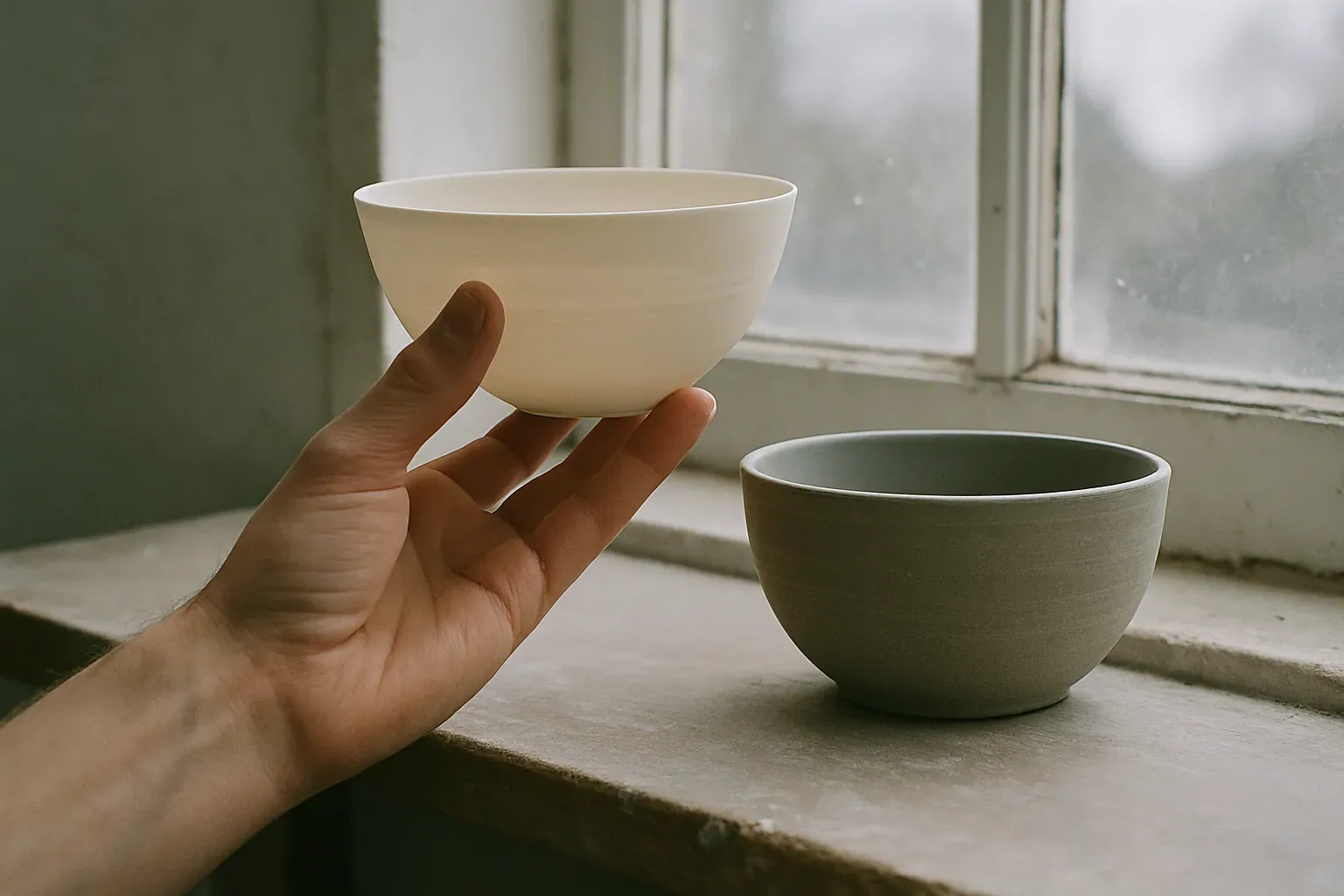
So the comparison people mean by "clay vs porcelain" is porcelain against the more common clay bodies. All of them are clay. They differ in recipe, the recipe sets the cone, and the cone decides almost everything else about how the pot behaves. For the wider family question, which word covers what, the ceramics versus pottery guide handles it. This page is about the bodies themselves and what each one asks of your kiln.
Is porcelain a type of clay?
Yes. Porcelain is a clay body, a recipe of clay plus minerals blended to fire a certain way, the same as any stoneware or earthenware on the shelf. One thing it is not: the porcelain on a bathtub or a sink, which is glass fused onto metal and has no clay in it. What changes between porcelain, stoneware, and earthenware is the proportion of flux in the mix, and that one change moves the firing temperature by hundreds of degrees.
How do clay bodies compare on absorption and shrinkage?
Porcelain shrinks the most and absorbs the least. Standard Clay publishes both numbers for every body it sells, and three of them line up cleanly: a low-fire white at cone 04 takes on 18.0% water, a mid-range stoneware at cone 6 takes on 2.25%, and a Grolleg porcelain at the same cone takes on 0.35%. Shrinkage runs the other direction.
| Clay body (Standard Clay) | Cone | Average shrinkage | Water absorption |
|---|---|---|---|
| 105 White, low fire | 04 | 6.5% | 18.0% |
| 112 Brown, stoneware | 6 | 11.0% | 2.25% |
| 365 Grolleg, porcelain | 6 | 13.5% | 0.35% |
Three bodies from one maker, so the figures were measured the same way. Cone temperatures are Orton equivalents at 108 F per hour: cone 04 is 1945 F (1063 C), cone 6 is 2232 F (1222 C).
Absorption is the number that carries the most meaning. It comes from boiling a fired sample, soaking it, then weighing the water it picked up, which is the ASTM C373 test the tile industry uses to sort bodies into classes. Those classes call anything at or under 0.5% impervious, 0.5 to 3.0% vitreous, and above 7% non-vitreous. So the porcelain lands in the impervious class, the stoneware one class down in vitreous, and the low-fire white at 18% is a different material by any practical measure.
Shrinkage matters at the other end of the job. A body that shrinks 13.5% from wet to fired moves noticeably more than one that shrinks 11.0%, so a handle attached a little too stiff, a foot that dried ahead of the rim, or a slab joined at the wrong moisture reports the difference as a crack. Measure your own rather than trusting the bag. Roll a test bar, scribe a 100 mm mark on it wet, and read that mark again after the glaze firing.
What is porcelain made of?
Three ingredients in close to fixed proportions. The Digitalfire reference puts a basic cone 10 porcelain at 50% clay (kaolin with a little ball clay), 25% feldspar, and 25% silica. The Ceramics Monthly Techno File on porcelain bodies gives the cone 10 standard as 55% kaolin, 20% silica, and 25% feldspar, plus about 2% of a modern plasticizer.
Feldspar is the dial. It is the flux, the part that melts and pulls the rest into a glassy matrix, and its percentage sets the cone the body matures at. Raise feldspar to 30% and that same recipe matures at cone 6. Cut it to 15% and the body wants cone 12 before it vitrifies. Stoneware sits lower on the dial and leans on a spread of particle sizes to reach density, which is how it gets to 2.25% absorption at cone 6 without turning to glass.
Whiteness comes from what is absent rather than what is added. Kaolin low in iron and titanium fires white, and a body clean enough on both counts will pass light through a thin wall. Standard describes its 365 as white and tight, translucent where the wall is thin, and notes it carries no ball clay at all. That last detail is why porcelain feels short and unforgiving on the wheel: ball clay is the plastic ingredient, and this recipe skips it.
Why does porcelain warp more than stoneware?
Feldspar again. Porcelain carries more of it on purpose, so at peak the body sits closer to its own melting point, and a body that soft will move.
Digitalfire is blunt on the point: among everything that makes fired ware warp, all the other factors combined matter less than the percentage of feldspar in the body.
Source: Digitalfire troubleshooting reference, warping.It is not the whiteness and it is not bad luck. A vitreous body is part glass at temperature, and glass sags. Industry answers this by firing its most vitreous ware in setters that hold the shape through the firing. In a studio the same problem shows up as rims that come out of round and overhung shapes that droop. It lands hardest on wide flat pieces with thin walls.
Two things you control matter more than the rest: even wall thickness and the peak. Even beats thin, because a wall that varies has a soft side and a stiff side at 2232 F. And overfiring by a single cone is enough to turn a stable form into a slumped one, which is the argument for a witness cone in every porcelain load rather than trust in the controller display.
Does porcelain need a different firing schedule?
The peak stays the same for a given cone, but the tolerance around it shrinks. Cone 6 porcelain and cone 6 stoneware both finish at 2232 F (1222 C), so the climb can look identical. What changes is the room at the top. A cone of overfire slumps the foot, and a cone short leaves the body porous and the glaze dull. Porcelain gives you less warning at either edge than a stoneware does.
There is a floor as well. Digitalfire puts the practical lower limit for feldspar acting as a vitreous body flux near 1180 C (2156 F), which sits a shade under cone 5 at 2167 F. Below that the flux never does its job. That is the reason there is no such thing as a cone 04 porcelain, while a low-fire white body sits at that cone and accepts its 18% absorption.
Bisque hardly changes at all. Porcelain bisques near cone 06, 1828 F (998 C), for the same reasons any clay does: drive off the water, burn out the organics, leave the ware porous enough to pull glaze out of suspension. Set the cone and the speed in the firing schedule builder and it writes the ramps and holds for you. For the mid-range setup most electric studios run, start from the worked cone 6 glaze firing schedule, and check any peak you are unsure of against the Orton cone chart.
The short version
Porcelain is one clay body among several, defined by a high feldspar content and clean white kaolin. That recipe buys density and whiteness, and light through a thin wall if you fire it right. It costs you plasticity on the wheel and a narrow window at the peak. Fire it to its cone and it comes out watertight without a drop of glaze on it. Miss by one cone and it either stays chalky or sits down on the shelf.
Sources
- Standard Clay Company, published shrinkage and absorption for the 105 White, 112 Brown, and 365 Grolleg Porcelain bodies (standardclay.com).
- Digitalfire reference glossary, porcelain, and the troubleshooting entry on warping (digitalfire.com).
- Ceramics Monthly, Techno File: Porcelain Bodies 201, Ceramic Arts Network (ceramicartsnetwork.org).
- ASTM C373 absorption classes as applied to tile bodies (impervious, vitreous, semi-vitreous, non-vitreous).
- Cone temperatures are Orton equivalents at a heating rate of 108 F per hour.
Build your firing schedule
Pick your cone, choose bisque or glaze, set a speed, and print the ramp and hold sheet free.