How to fire clay without a kiln
To fire clay without a kiln, dig a shallow pit or punch air holes in a steel drum, bed bone-dry pots in sawdust, pile wood on top, and let it burn for one to four hours. An open fire peaks somewhere between about 1000 and 1860 F (538 and 1016 C), hot enough to turn clay into ceramic that won't soften back into mud. The pots come out hard and smoke-marked but porous, so they're for display, not for food or water.
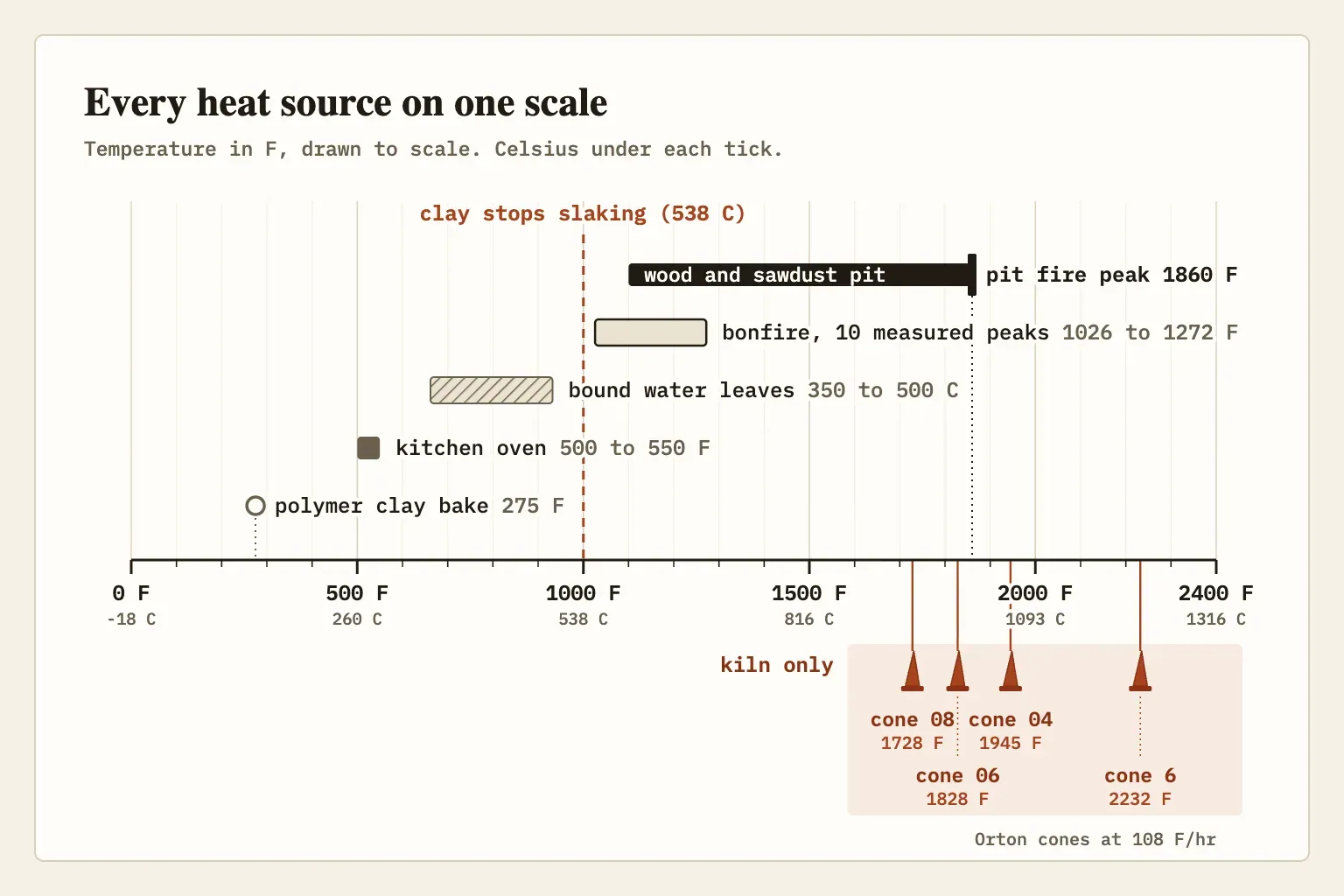
Clay changes for good at a far lower heat than a kiln fires to. Digitalfire, Tony Hansen's ceramic reference, puts the loss of the water locked inside the clay crystal at about 662 to 932 F (350 to 500 C), and no amount of soaking brings it back. Fired to 1000 F (538 C), barely red heat, clay sinters into a piece that no longer slakes when it gets wet. A wood fire gets hotter than that without trying. What a fire can't do is climb slowly or heat every side of a pot the same. It also can't hold the 1828 F a low-fire glaze needs. Most of this guide is about working around those limits.
How hot does a pit fire get?
Between about 1000 and 1860 F (538 and 1016 C) at the peak, depending on the fuel and how well the fire is covered. In 2018 the archaeologist Maria-Louise Sidoroff ran ten camel-dung bonfires in Jordan and logged a median peak of 596 C (1105 F). A wood and sawdust pit runs hotter: Eduardo Lazo's pits easily reach 1860 F.
Those are peaks, and they don't last. Sidoroff's paper in the EXARC Journal sums up the ethnographic record: a bonfire reaches its top temperature in about 20 minutes on average (Gosselain 1992, Rice 1987), and readings across non-kiln firings fall between 600 and 900 C (1112 and 1652 F). The same fire is never one temperature, either. A 2019 Archaeometry study, citing Owen Rye's Pottery Technology (1981), notes that one gust of wind can drop the heat at a spot by as much as 200 C (360 F).
Sidoroff set Orton cones beside her pots as a check. Cone 018, which Orton rates at 1319 to 1353 F depending on how fast the heat climbs, blistered but never bent. Cone 016 came out unchanged. Lazo reads his pit by color instead. Green copper fumes rise from the flames once it reaches about 1100 F (593 C), and the salt starts working near 1400 F (760 C).
| Heat source | Peak temperature | What happens to the clay |
|---|---|---|
| Kitchen oven | 500 to 550 F (260 to 288 C) | Dries it. It's still raw clay and slakes back to mud in water. |
| Polymer clay in the oven | 275 F (135 C) | Cures a plastic. Nothing ceramic happens, because it isn't clay. |
| Dung bonfire, measured | 1026 to 1272 F (552 to 689 C) | Sinters. It holds its shape in water but stays soft and highly porous. |
| Wood and sawdust pit | Up to 1860 F (1016 C) | Sinters harder in the hot spots. Porous, smoke-marked, uneven. |
| Kiln, cone 08 bisque | 1728 F (942 C) | An even bisque all the way through, the same every time. |
| Kiln, cone 04 bisque | 1945 F (1063 C) | The standard studio bisque. |
| Kiln, cone 6 glaze | 2232 F (1222 C) | Stoneware turns dense and the glaze melts to glass. |
The bonfire range runs from the coolest to the hottest of Sidoroff's ten measured peaks. The pit figure is Lazo's. Kiln figures are Orton self-supporting cone equivalents at 108 F per hour, the same numbers as the Orton cone chart.
Can you fire clay in a regular oven?
No. A home oven tops out around 500 to 550 F (260 to 288 C), and the water bound inside clay doesn't leave until about 662 to 932 F (350 to 500 C). Whatever comes out of the oven is dry clay, and it turns back to mud in a bucket of water.
Oven-bake clay is a different material: Sculpey is a plastic that cures at 275 F for 15 minutes per quarter inch of thickness.
The oven does earn a place in real firing, though. Water left in a pot is what makes it burst in a fire, and warming pots at around 200 F, under the 212 F boiling point, drives off the last of it before they meet the flames. It's the same idea as candling and preheating a kiln load, done in the kitchen. Jane White, who has pit fired for 20 years, dries any pot that got a wet salt solution in an oven or kiln first, because a damp pot cracks in the pit.
Air-dry clay is no shortcut. It hardens as it dries, not in heat, so read the packet before you put any near a fire.
Pick a clay that can take the shock
The clay matters more here than in a kiln, because the fire won't go easy on it. Digitalfire's entry on primitive firing says the old methods used coarse clays, with terra cotta for anything practical, and that potters now add grog where ancient potters used sand, so the body survives heat that arrives fast. Grog is fired clay ground to grit. Jane White goes further and uses a raku body that's 58 percent molochite, a pre-fired kaolin grog, because the heat in a pit rises and falls with no control at all.
Shape counts too. White trims her walls to an even thickness, since a thick spot beside a thin one pulls apart as the pit cools. Hollow out anything sculpted. Then let the pieces dry until they're bone dry, which means a pot no longer feels cool against your cheek. If you dug the clay yourself, the tests in the guide on where to find clay tell you whether it's worth firing. Most dug clay is low-fire earthenware, and that suits a pit well.
Bisque it first if you can
Lazo and White both put bisqued pots in the pit, not raw ones. White bisques to 1688 F (920 C). That's low enough to leave the clay open, and the whole pit-firing look depends on bare, absorbent clay taking up smoke and fumes. Bisque ware has no water left to turn to steam, and it's far stronger than greenware, so the pit only has to color it. Raw pots can go in too. That's how pots were fired for thousands of years, but expect to lose more of them.
If you can get one firing at a studio or a school, ask for a low bisque. Cone 08 is 1728 F (942 C), close to White's number. The firing schedule builder writes the slow cone 08 program in five ramps: 80 F per hour to 250 F, 200 to 1000 F, 100 to 1100 F, 180 to 1478 F, then 80 to the 1728 F peak. That's about 12 hours 10 minutes in all. Print it and hand it to whoever runs the kiln.
How do you pit fire pottery?
Dig a pit at least a foot deep or use a steel drum with air holes, lay down sawdust, pack warm, bone-dry pots in close, cover them with wood, and burn it for one to four hours. Then lay metal over the top and leave it to cool overnight or longer. Here's the order, from Lazo's and White's published methods.
- Pick the spot. A traditional pit can hold hundreds of pots, but Lazo fires small loads in a 55-gallon steel drum (the barrel in barrel firing) with 1-inch air holes every 8 inches, or in an iron or concrete fire ring sunk at least 12 inches below ground. Clear rocks and glass from the base. Check your local burn rules first, since many areas ban open fires in dry months.
- Lay a bed of sawdust. White puts about 8 inches (20 cm) of hardwood sawdust in the bottom. Hardwood is denser and gives darker, richer marks, and any part of a pot buried in it comes out black.
- Warm the pots. Keep them in a 200 F oven until you load, or set them beside a small fire first. Sidoroff's warming fires ran a median of 20 minutes before the real firing began.
- Pack them close. Nest the pots in the sawdust so they touch. White packs tight because it holds the heat in and slows the cooling, and the narrow gaps between pots go smoky and dark. For color, sprinkle copper carbonate and salt around the pots, not on them, and wear a respirator.
- Build the fire. Lay a metal grid over the pots, then wood, then straw and paper so it catches fast. Lazo's pit burns hard for about an hour. White's burns for 3 to 4 hours.
- Slow the cooling. Cover the pit with metal sheets once the fire burns low. White does it while it's still smoldering, and Lazo covers his at about 500 F (260 C) to keep the wind off the ware.
- Wait. Leave it alone until it's cold, and White unpacks hers 48 hours later. Brush off the ash, don't soak the pots, and rub in two coats of paste wax for a soft shine.
Anything that comes out of a pit is decorative. Lazo's rule is that pit-fired pots aren't safe for food, for a flame, or for an oven, and the wax on the surface doesn't change that.
Source: Eduardo Lazo, "A Pit Firing Color Palette," Pottery Making Illustrated, Nov/Dec 2016.Why do pots crack or explode in an open fire?
A fire heats too fast and too unevenly. A bonfire hits its peak in about 20 minutes, a climb of roughly 3,000 F an hour, while the builder's slow bisque takes 2 hours 11 minutes to reach 250 F. Water left in the clay flashes to steam past 212 F (100 C), and thick walls give it nowhere to go.
Heat that arrives on one side only does the rest. The silica in clay expands suddenly at quartz inversion, 1063 F (573 C), and shrinks back through the same point on the way down. In a kiln, the whole pot passes through it together. In a pit, the side facing the wind can run 200 C cooler than the side in the coals, so one wall changes size while the other doesn't. The fixes are the ones above: grogged clay, even walls, a warm start, bisque ware packed tight, and metal over the pit for the cool-down.
Can you glaze pottery without a kiln?
Not in a pit. A low-fire glaze has to melt at about cone 06, 1828 F (998 C), over the whole pot and stay there long enough to smooth out. A pit might touch that in its hottest pocket for a few minutes while the far side of the same pot sits hundreds of degrees cooler.
Pit-fired color comes from smoke, copper, salt, and polished clay instead, and burnishing is the closest thing to a glaze shine. White burnishes her pots on the wheel with polished stones once they've firmed up a little. Once they're bone dry she brushes on three coats of terra sigillata, a fine, settled slip, and buffs them with a soft cloth until they gleam. If you want real glaze without an electric kiln, raku is the next step. It fires to around cone 06 in a small propane kiln, and people build those from steel trash cans. That's still a kiln, though, which is the thing you set out to skip.
Or rent space in someone's kiln
For anything you want to drink from, a studio kiln costs less than you'd guess. Many community studios fire outside work by the cubic inch, so you multiply the piece's height, width, and depth. BKLYN Clay in New York charges members and students 4 cents per cubic inch per firing and everyone else 8 cents. It bisques to cone 06 and turns work around in 7 to 10 days.
Carrie Wiederhold, writing in Ceramics Monthly about her studio, Gailanna Pottery in Michigan, works through a 4 by 3 by 5 inch mug. That's 60 cubic inches, and at 6 cents it comes to $3.60 for the bisque and the glaze firing with her studio's glazes. At BKLYN Clay's outside rate the same mug costs $4.80 per firing. Some studios will rent you a whole kiln and expect you to bring the program. The same builder writes bisque programs for cones 08 to 04 and glaze programs for cones 06 to 10, with every ramp, every hold, and the total time, in F or C.
The short version
Fire bone-dry, grogged pots in a pit or a perforated drum. Warm them first, pack them tight, burn for one to four hours, and cover the pit to cool overnight. You'll get hard, smoke-patterned pieces that hold up on a shelf. For a mug, a bowl, or anything that holds water, bisque and glaze it in a kiln, and save the pit for the pieces you want to look at.
Sources
- Digitalfire Reference Library (Tony Hansen), glossary entries for primitive firing and dehydration: chemically combined water leaves at about 350 to 500 C, clay fired to 1000 F no longer slakes, primitive ware is sintered rather than vitrified (digitalfire.com).
- Maria-Louise Sidoroff, "Experimental Bonfirings of Pottery with Camel Dung Fuel, Jordan, July 2018," EXARC Journal 2019/2: ten firings, median peak 596 C, highest 688.9 C, cone 018 blistered but not bent, and the ethnographic summary citing Gosselain (1992), Rice (1987) and Matson (1971) (exarc.net).
- M. Admiraal, A. Lucquin, L. Drieu et al., "Leftovers: The presence of manufacture-derived aquatic lipids in Alaskan pottery," Archaeometry, 2019: open fires reach 600 to 900 C and wind can cut local temperature by up to 200 C, after Rye (1981) (doi.org/10.1111/arcm.12515).
- Eduardo Lazo, "A Pit Firing Color Palette," Pottery Making Illustrated, Nov/Dec 2016, excerpted from Naked Raku and Related Bare Clay Techniques (ceramicartsnetwork.org).
- Jane White, "Out of the Fire," Pottery Making Illustrated, July/August 2024 (ceramicartsnetwork.org).
- Carrie Wiederhold, firing fee box and cubic-inch rates at Gailanna Pottery, Ceramics Monthly, via Ceramic Arts Network (ceramicartsnetwork.org).
- BKLYN Clay, outside firing rates and turnaround (bklynclay.com).
- Sculpey, baking polymer clay (sculpey.com).
- Cone temperatures are Orton self-supporting cone equivalents at a heating rate of 108 F per hour, with the 270 F per hour column given for cone 018. The cone 08 slow bisque and its 12 hr 10 min total are computed by the KilnSchedule builder: cone 08, bisque, slow, 75 F start.
Build a bisque schedule for your pit pots
Pick cone 08, bisque, and slow, and print the ramp and hold sheet free for whoever fires your kiln load.