Stoneware vs earthenware: how the cone changes the pot
Stoneware and earthenware are both clay. The difference is heat. Earthenware matures around cone 04, 1945 F (1063 C), and stays porous, so it needs glaze to hold water. Stoneware goes on to cone 5 to 10, 2167 to 2345 F, and vitrifies into a dense body. Standard Clay's cone 6 stoneware absorbs 2.25% of its weight in water. Their low-fire white absorbs 18.0%.
Almost everything else follows from that gap. How strong the pot is, whether it chips, whether it leaks through a crack in the glaze, even how it takes a flame: all of it traces back to how far the clay was pushed toward glass in the kiln. The names on the bag are shorthand for a cone.
What is the difference between stoneware and earthenware?
Firing temperature, and what that heat does to the clay. Earthenware is fired low, cone 06 to 04 (1828 to 1945 F), and its particles never fully fuse, so a typical terra cotta keeps 10 to 15% porosity. Stoneware is fired about 300 F hotter, where feldspar melts into glass, fills the gaps, and leaves a body that takes on 3% water or less.
Digitalfire, Tony Hansen's ceramic reference, puts it in one line: earthenware lacks the glass development to fill the voids and glue the particles together. That missing glass is the whole story. Iron-red terracotta, white low-fire bodies, and majolica clays all fall on the earthenware side of it. Grey, buff, and brown throwing bodies at cone 6 or cone 10 fall on the stoneware side.
Standard Clay publishes shrinkage and absorption for every body it sells, measured the same way, so three of its clays make a fair side-by-side:
| Clay body | Cone | Peak at 108 F per hour | Fired shrinkage | Absorption |
|---|---|---|---|---|
| 105 White, low-fire earthenware | 04 | 1945 F (1063 C) | 6.5% | 18.0% |
| 417 Red earthenware | 04 | 1945 F (1063 C) | 11.0% | 3.5% |
| 417 Red earthenware | 02 | 2016 F (1102 C) | 12.0% | 1.4% |
| 112 Brown stoneware | 6 | 2232 F (1222 C) | 11.0% | 2.25% |
Figures from Standard Clay Company's published body data. Peak temperatures are Orton self-supporting cone equivalents at a final heating rate of 108 F per hour.
The 417 row is the one that surprises people. It is an earthenware, and at cone 02 it is tighter than the stoneware. Red clays carry a lot of iron, and iron is a flux, so a dense red body can reach stoneware-level absorption at a low cone. Digitalfire's terra cotta page shows the same thing: about 10 to 12% porosity at cone 04, under 4% at cone 02. So "earthenware is porous" is a rule about the cone more than about the clay. Fire a red body two cones hotter and it changes character.
Is stoneware better than earthenware for dishes?
For plates and mugs that go through the dishwasher every day, yes. Vitrified stoneware is harder, chips less at the rim, and holds water even where the glaze is thin or missing. Earthenware can be food-safe too, but only while its glaze stays intact, since the body underneath will soak up whatever gets through.
The weak spots on earthenware are the unglazed foot and any crack in the glaze. Water wicks up through the bare foot in the dishwasher. Birch Lane's dinnerware guide notes that most glazed earthenware is dishwasher safe but not microwave safe, while most stoneware is both, which lines up with the absorption numbers in the table.
Earthenware has real advantages, though. Low-fire glazes hold bright reds, oranges, and yellows that are much harder to keep at cone 6. The clay is softer to trim and the firing is shorter and cheaper. For serving bowls, planters, tiles, and decorative work, those trade-offs are often worth taking.
Why does earthenware leak or craze over time?
Because a porous body keeps taking on moisture after it leaves the kiln. Digitalfire describes the mechanism: an earthenware piece with an unglazed foot lets water wick up into the walls, the body swells slightly as it absorbs it, and a glaze that fit on the day it was fired ends up crazing months later. Once the glaze has cracks, water has a path in.
That delayed crazing is the classic earthenware failure, and stoneware mostly avoids it because a vitrified body has little room left to take on water. The fix on the earthenware side sits in the firing. Digitalfire points out that a hotter bisque gives a denser body with a higher thermal expansion, which squeezes the glaze and stops it crazing. Glazing the foot, or sealing it, closes the other door.
A glaze that fits its body and does not craze will seal that body against water, however porous the clay under it is. Leaking earthenware is a glaze-fit problem as often as a clay problem.
Source: Digitalfire reference, leaking of fired ceramics (digitalfire.com).Which handles heat better, stoneware or earthenware?
Earthenware, and by a wide margin. The same porosity that lets it leak lets it flex when one side heats faster than the other. In a Digitalfire flame test, a glazed terra cotta cup survived 25 seconds under a direct flame before cracking, where typical stonewares and porcelains last about 10. An unglazed terra cotta cup lasted 30.
That is why cooking pots meant for a stovetop or open fire have long been low-fired, porous clay. The tiny voids in the body stop a crack from running. A dense stoneware casserole is fine in an oven that heats it evenly, but it is the wrong material to set on a gas burner. Standard's product page says its 417 red body contains Pyrex for thermal shock resistance, so the maker is leaning into the same strength.
Can you fire earthenware to stoneware temperatures?
No. Earthenware does not keep getting denser as the kiln climbs. It hits a limit and then falls apart. Digitalfire puts the maximum density of terra cotta near 2000 F, then warping and blistering by cone 01 (2046 F) and melting by cone 2 (2088 F). A cone 6 firing at 2232 F is well past that, and the pot can slump into a puddle on your shelf.
That makes the bag's cone range a hard limit, not a suggestion. One earthenware piece in a cone 6 load can glue itself to a kiln shelf and drip onto the one below.
The reverse is safer but still a bad trade. Fire a cone 6 stoneware only to cone 04 and nothing melts, but the feldspar never gets hot enough to do its job, so the body stays porous and weak. You end up with a pot that has the drawbacks of earthenware and none of its bright low-fire glaze colors.
How the firing schedule changes
The bisque barely changes. Both clays bisque around cone 06 to 04, and the slow early segments are the same for both: drive the water out below 250 F, burn out organics below 1000 F, and ease through quartz inversion at 1063 F (573 C). The difference comes in the glaze firing, when each clay climbs to its own maturing cone.
Cone 6 stoneware ends 287 F (159 C) higher than cone 04 earthenware. On a medium-speed program in the firing schedule builder, that adds up to 8 hours 13 minutes to reach cone 6 against 7 hours 23 minutes to reach cone 04, only 50 minutes apart, because the extra climb runs at a fast rate before the slow final 250 F. The bigger costs of cone 6 are element wear and power, and the comparison of cone 04, 6, and 10 firing ranges covers both.
If you fire a dense red earthenware, try cone 02 before assuming you need stoneware. At 2016 F the Standard 417 body drops to 1.4% absorption, a number most cone 6 stonewares do not beat. Watch it closely, though, since cone 01 is where terra cotta starts to blister. For the exact temperature at each step between those cones, read it off the Orton cone chart.
How to tell stoneware from earthenware on a finished pot
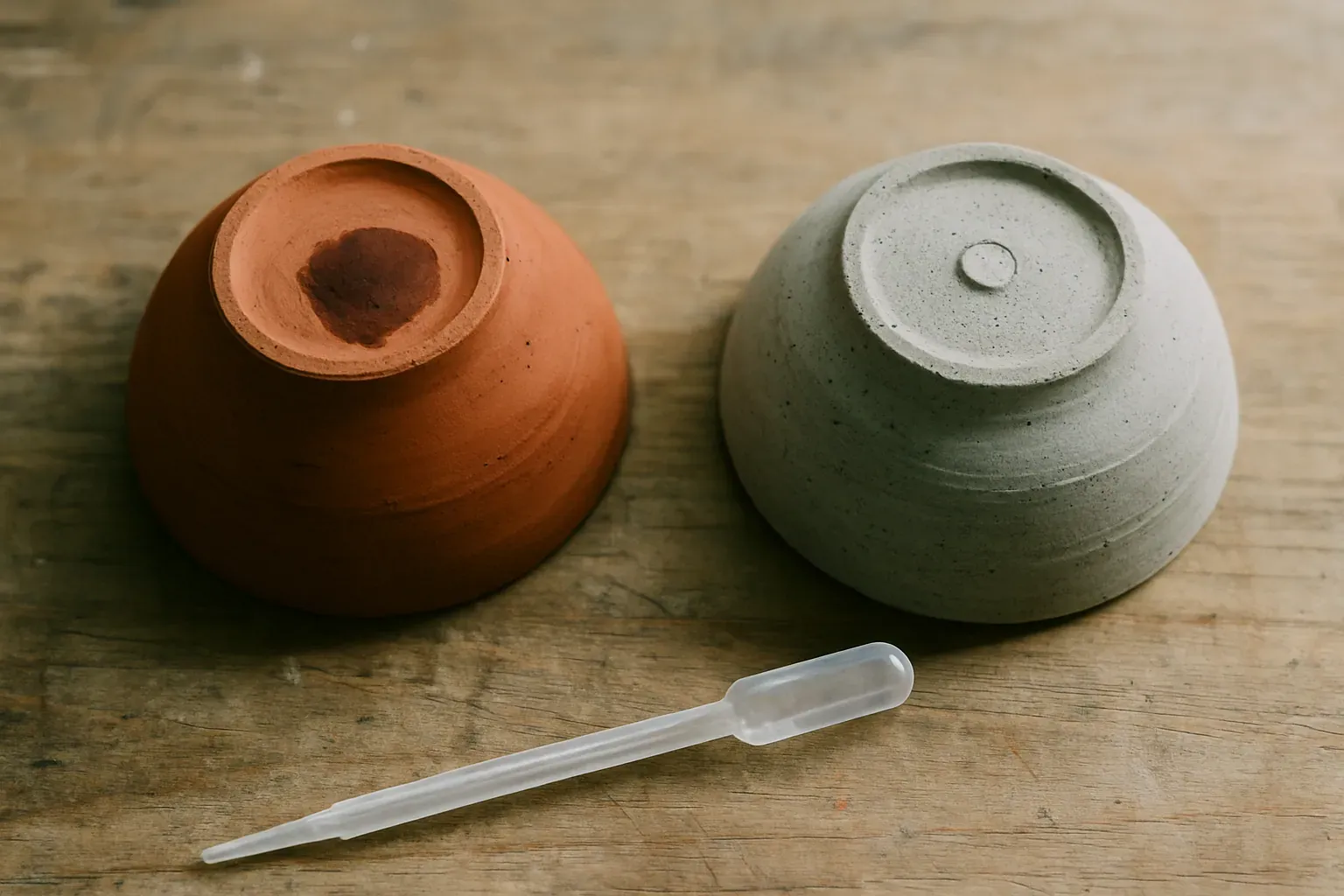
Turn it over and look at the foot. Red or orange, chalky to the touch, and quick to scratch with a key: earthenware. Grey, tan, or brown, dense and a little glassy: stoneware. Tap the rim with a fingernail. Vitrified stoneware rings, while earthenware gives a shorter, duller note. A drop of water on the bare foot settles it, since earthenware drinks it in and stoneware leaves it beaded.
For a number instead of a guess, run the absorption test below. It is the same weigh, boil, and weigh-again method Digitalfire uses to measure porosity, and you can do it at home with a kitchen scale. For how these two bodies compare with the densest one, see clay vs porcelain.
- Fire a small unglazed tile of the clay to its cone.
- Weigh it dry on a scale that reads to 0.1 g.
- Boil it in water, let it cool in the water, then pat the surface dry.
- Weigh it again. Wet weight minus dry weight, divided by dry weight, is the absorption. A 50.0 g tile that comes out at 51.1 g absorbs 2.2%, a stoneware number. One that comes out at 56.0 g absorbs 12%, which is earthenware territory.
Pick the clay, then set the cone
If the pot will live in a dishwasher, pick a stoneware and fire it to its cone, most often cone 6 in an electric kiln. If you want bright color, a quick firing, or a pot for the stove, pick an earthenware and fire it to cone 04, or cone 02 if the bag allows it. Then set that cone, bisque or glaze, and the speed in the firing schedule builder and it writes the ramps and holds for you, in F or C.
Sources
- Standard Clay Company, published cone range, shrinkage, and absorption for the 105 White, 417 Red Earthenware, and 112 Brown bodies (standardclay.com).
- Digitalfire reference (Tony Hansen), glossary entries on earthenware, terra cotta, stoneware, and clay body porosity, plus the troubleshooting page on leaking of fired ceramics (digitalfire.com).
- Birch Lane, Dinnerware Materials 101: stoneware and earthenware care, dishwasher and microwave use (birchlane.com).
- Orton pyrometric cone temperature chart, self-supporting cones at 108 F per hour (ortonceramic.com).
- Firing times are computed by the KilnSchedule builder on medium speed from a 75 F start, glaze firing, empty kiln.
Build your firing schedule
Pick your cone, choose bisque or glaze, set a speed, and print the ramp and hold sheet free.