Cone 6 glaze firing schedule
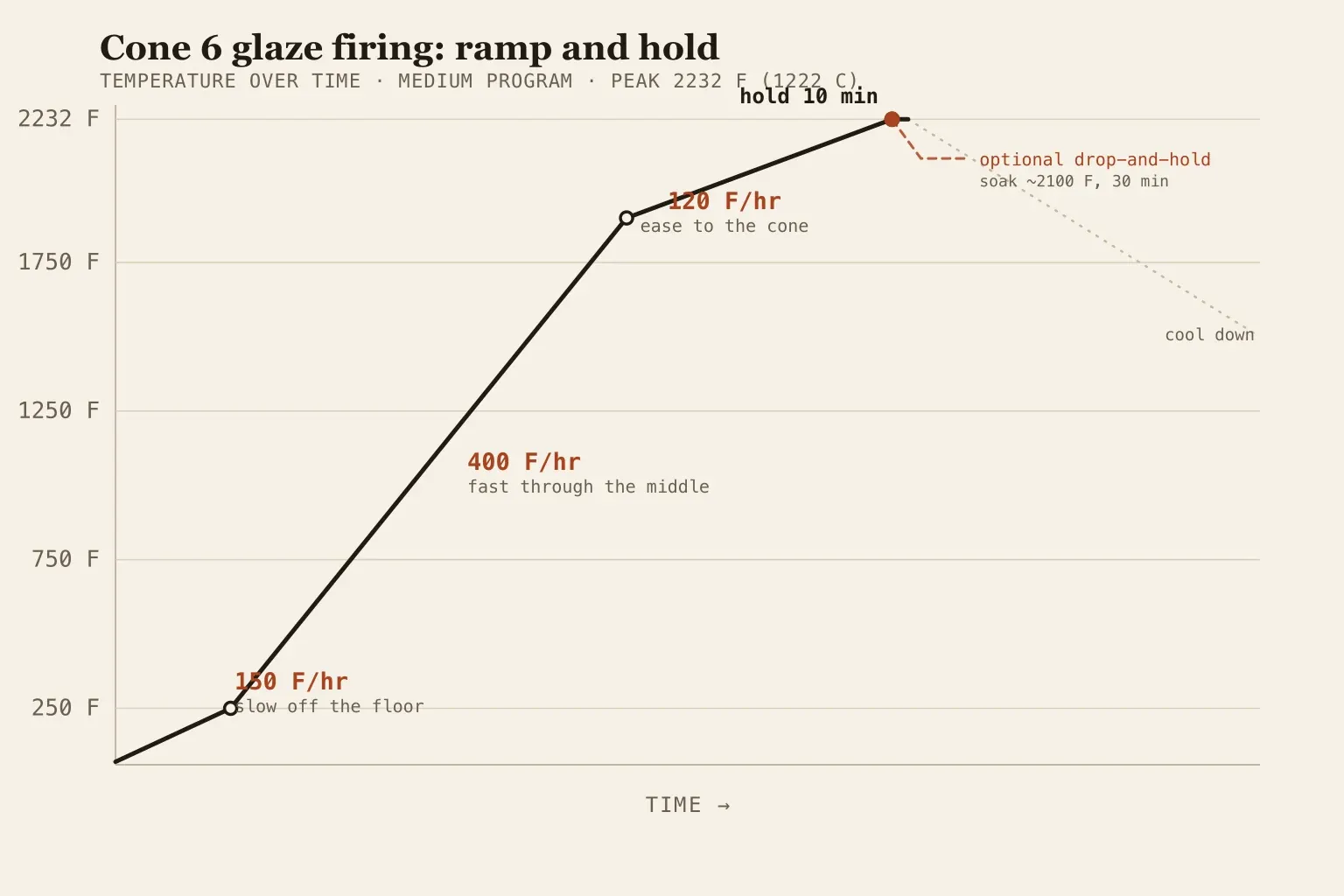
A cone 6 glaze firing climbs to about 2232 F (1222 C) at the standard 108 F per hour rate, usually with a short hold at the top so the glaze melt levels out. A common medium program ramps slow off the floor, faster through the middle, then eases over the last 200 F to land the cone.
What is a good cone 6 glaze firing schedule?
A reliable starting point is a three-segment ramp with a short hold at the top. Climb slowly off the floor to clear moisture, move quickly through the middle while the bisqued body is dry, then slow over the last 200 F so the final heat-work lands cone 6 exactly. This is the shape most factory medium programs use, and it is the default the schedule builder lays out for a cone 6 glaze.
| Segment | Ramp | To target | Hold | Why |
|---|---|---|---|---|
| 1 | 150 F/hr | 250 F | 0 min | Clear surface moisture gently |
| 2 | 400 F/hr | 1900 F | 0 min | Body is dry, so climb fast |
| 3 | 120 F/hr | 2232 F | 10 min | Ease to the cone, then soak the melt |
Cone 6 bends at about 2232 F (1222 C) at the standard 108 F per hour. Push the same cone at 270 F per hour and it needs roughly 2269 F (1243 C) to bend. That 37-degree gap is heat-work, which is why the final ramp matters more than the peak number alone.
Source: Edward Orton Jr. Ceramic Foundation, pyrometric cone temperature chart (ortonceramic.com).How do I add a drop-and-hold to fix pinholes?
Cool fast to about 100 to 150 F below peak, then hold there for 20 to 30 minutes while the glaze is still fluid. A glossy cone 6 glaze that pinholes or blisters often heals during that soak, because the melt is liquid enough to close the holes but no longer pulling fresh gas out of the body. A worked example from digitalfire holds five minutes at peak, drops to about 2100 F, then soaks 30 minutes there.
The builder offers this as an option on glaze firings, so you can compare a plain top hold against a drop-and-hold without doing the arithmetic by hand.
Fast, medium, or slow: which cone 6 speed?
Speed changes the heat-work and the look. A fast program saves time and energy and suits simple, forgiving glazes. A medium program is the safe default for most studio work. A slow program, or one with a controlled cool, gives more even results and lets reactive glazes develop. If you want matte or crystalline surfaces, read the guide on slow cooling for glaze effects, which adds a cooling ramp below the peak.
Build your cone 6 schedule
Pick cone 6, choose glaze, and set a speed in the schedule builder. It reads the peak from the Orton cone chart at the right rate, fills in the ramps and the optional hold, and prints a clean sheet to tape to the kiln. If you are new to programming a controller, the how firing schedules work guide explains every number first.
Sources
- Orton pyrometric cone temperature chart, ortonceramic.com.
- Digitalfire PLC6DS and C6DHSC cone 6 firing schedules, digitalfire.com.
- Techno File: Kiln Firing Schedules, Ceramic Arts Network (ceramicartsnetwork.org).
Build a cone 6 glaze schedule
Pick the cone, choose glaze, set a speed, and print the ramp and hold sheet free.